
Sales and Marketing
Lead Generation Software for CIPP Contractors in 2026
CAST handles Florida residential parcel targeting. Google Ads captures active search demand. Google Business Profile supports local discovery. HubSpot CRM organizes inquiry follow-up. This 2026 guide examines lead generation software for CIPP contractors by the job each option handles.
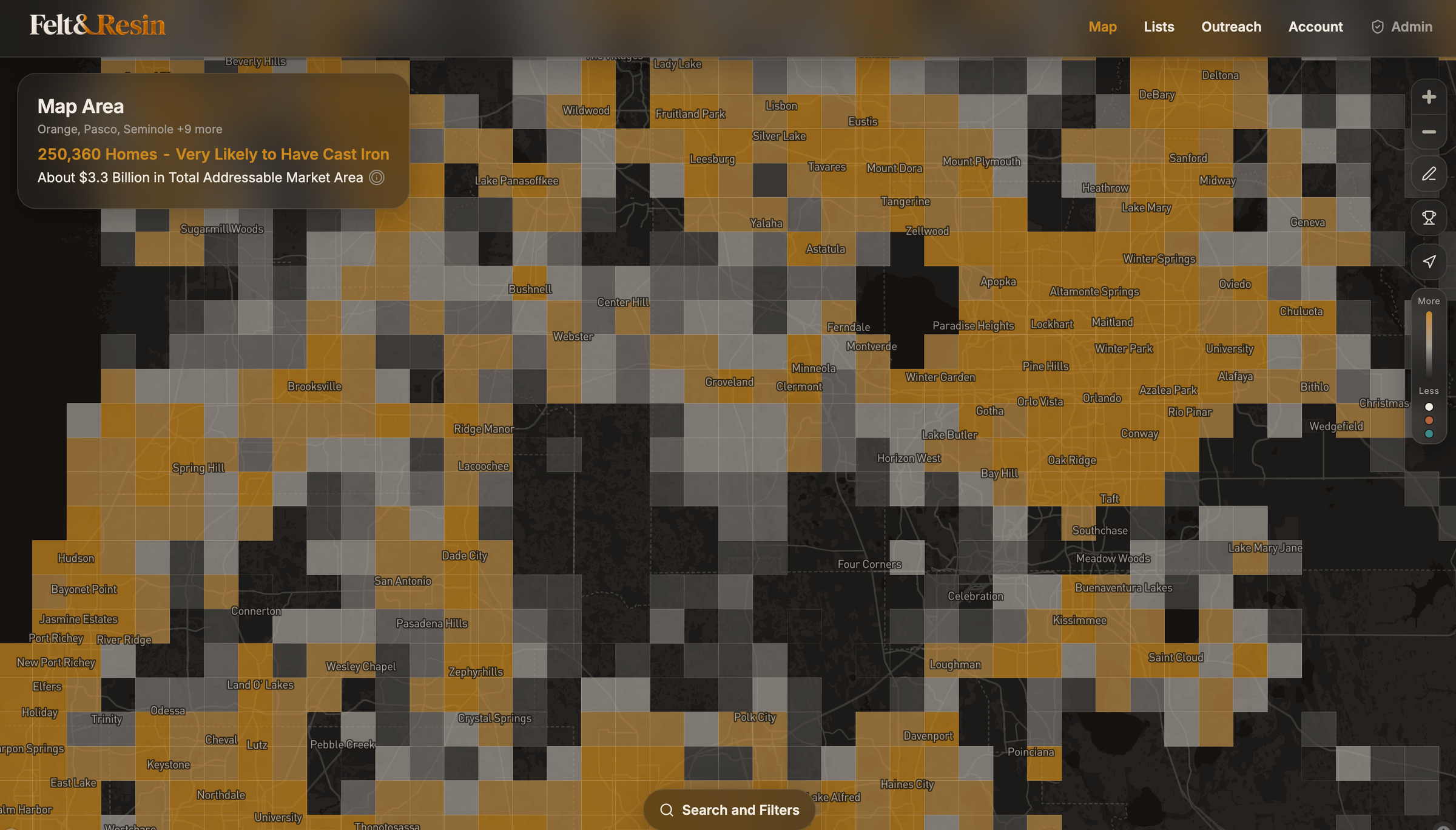
Felt & Resin serves trenchless pipe rehabilitation contractors across residential, high-rise and condominium, municipal, and commercial segments nationwide. CAST (Cast-Iron Analysis, Scoring, and Targeting) is its residential-focused targeting database.
Why This Matters
CIPP lead generation starts with a distinction: a property that fits your target market is not the same thing as a homeowner asking for an inspection. Your software needs to match the work you need done. Otherwise, you end up measuring contacts when you need qualified opportunities.
For a 2026 buying decision, separate territory intelligence from demand capture and sales follow-up. CAST addresses where to target residential prospecting in Florida. Google Ads and Google Business Profile help you reach people searching for services. HubSpot CRM helps you manage the inquiries that reach your business.
Felt & Resin's CAST supports Florida residential CIPP contractors targeting cast-iron-era homes at the parcel level. That is a specific use case, not a claim that every scored parcel needs lining. The firm's broader market intelligence work serves other pipe rehabilitation segments as well.
How to Evaluate Lead Generation Software for CIPP Contractors
Use these criteria before reviewing features. A long feature list does not tell you whether a tool helps your crew find suitable work.
- Territory Relevance: The tool must support the geography you actually serve. For outbound targeting, evaluate property relevance rather than contact volume alone.
- Buyer Intent: Distinguish a potential property from an active inquiry. Those records need different messages and different follow-up.
- Trade Relevance: Your marketing must describe the pipe rehabilitation work you perform. General plumbing interest does not establish a CIPP opportunity.
- Operational Handoff: Decide how a record becomes an assigned task, an inspection appointment, and a proposal. Do not leave ownership unclear.
- Outcome Visibility: Track the original source through qualification and inspection. A submitted form is not proof of suitable pipe conditions.
- Claim Discipline: Targeting data can guide outreach. Only property-specific investigation can establish whether rehabilitation is appropriate.
Buy for the missing step in your operation. If your territory is undefined, a follow-up system does not solve that problem. If inquiries are already arriving but nobody owns the next action, another targeting source does not fix the handoff.
Lead Generation Options at a Glance for 2026
These options cover different parts of the same sales process. CAST is a residential parcel-targeting database. The others support advertising, local discovery, or contact management. Treat the table as a task map, not a ranking of interchangeable products.
| Option | Use Case | Core Function | Operating Requirement |
|---|---|---|---|
| CAST | Florida residential parcel targeting | Parcel-level scoring for cast-iron-era homes | Investigate pipe condition and qualify homeowner intent separately |
| Google Ads | Active search demand | Search advertising tied to selected queries | Qualify inquiries for job suitability |
| Google Business Profile | Local discovery | Business presence in Google Search and Maps | Maintain accurate information and an inquiry intake process |
| HubSpot CRM | Inquiry follow-up | Contact records, tasks, and deal tracking | Assign owners and keep records current |
1.CAST: Florida Residential Parcel Targeting
CAST is Felt & Resin's residential parcel-level targeting database for cast-iron-era homes across all 67 Florida counties. Its scores are statistical estimates from modeled inference about whether original cast-iron drain pipe remains in place and is likely to be failing. Coverage and model descriptions are documented on the CAST product page, accessed October 7, 2026.
Scores and estimated footage are not inspections, measurements, or takeoffs. They must not be used as the basis for a price quoted to a homeowner. You use the intelligence to decide where to focus prospecting rather than treating every property in your service area alike.
For a residential CIPP contractor, CAST belongs before homeowner engagement and inspection. It helps define the property audience. Whether the owner wants an inspection, and whether the pipe is suitable for rehabilitation, remain separate questions.
CAST Functions
- Trade-Specific Purpose: CAST targets Florida residential properties relevant to residential CIPP contractors.
- Parcel-Level Focus: The targeting unit is the property, rather than a broad audience category alone.
- Florida Coverage: The database covers all 67 counties. Check current record availability in the territory you intend to work.
- Outbound Planning: Property intelligence gives you a basis for deciding where to direct prospecting effort.
CAST Operating Requirements
- Territory Selection: Select parcels within your Florida residential service territory before planning outreach.
- Property Investigation: Confirm pipe material, condition, and rehabilitation suitability through property-specific investigation.
- Homeowner Qualification: Establish interest, access, and a next action rather than treating a target record as an inquiry.
Use Case: Florida residential CIPP contractors who need a defined property audience for outbound prospecting.
Before making CAST part of your workflow, decide how your team will act on a target parcel. Review what supports the score, how records are maintained, and how selected properties move into outreach. Those questions turn a targeting purchase into an operating decision.
Use CAST to plan Florida residential prospecting. Confirm pipe condition and CIPP suitability through property-specific investigation.
2.Google Ads: Active Search Demand
Google Ads lets you place search advertising around selected queries. For CIPP contractors, its role is demand capture: reaching people who are already searching for a service or trying to understand a pipe problem.
Search intent still needs qualification. Someone researching sewer repair is not automatically a fit for lining, and someone searching for a plumbing repair might need work your crew does not perform. Your ad, destination page, and intake process need to describe the service accurately.
Google Ads Functions
- Search Relevance: Build campaigns around the services and problems your business addresses.
- Geographic Controls: Location targeting helps align advertising with your service territory.
- Message Control: Ads let you state your service focus before a person contacts you.
- Inquiry Measurement: Conversion tracking can connect selected website actions to advertising activity.
Google Ads Operating Requirements
- Query Review: Review broad or ambiguous searches for inquiries unrelated to the work you want.
- Inquiry Qualification: A recorded website action does not establish pipe condition or an accepted project.
- Intake Ownership: Give each inquiry an owner and a next action. Campaign settings cannot perform that handoff.
Use Case: CIPP contractors who want to capture active search demand within their service area.
Build the campaign around services you actually provide. Keep research queries distinguishable from queries expressing a request for service, and review search terms for mismatches. Do not advertise a diagnostic conclusion before an inspection supports it.
Use Google Ads to capture search demand when you have a clear service offer and an assigned owner for inquiry intake.
3.Google Business Profile: Local Discovery
Google Business Profile gives eligible businesses a presence in Google Search and Maps. It helps searchers understand your business, review service information, and find ways to contact you.
This is a local discovery tool. It belongs in your operation when potential customers need to identify a contractor serving their area. A person finding your profile is at a different point in the sales process from a property selected for outbound targeting.
Google Business Profile Functions
- Local Presence: Your business can appear where people search for nearby service providers.
- Service Information: A profile lets you explain what the business does and how customers can reach it.
- Customer Feedback: Reviews give prospective customers access to feedback from other customers.
Google Business Profile Operating Requirements
- Accurate Details: Keep business information consistent with the services and territory you actually serve.
- Visibility Expectations: Maintaining a profile does not guarantee a particular search position or inquiry volume.
- Inquiry Handling: Assign responsibility for contacts that arrive through the profile and record their outcomes.
Use Case: CIPP contractors who need accurate local business information available to searchers.
Describe the actual services your company performs. Keep contact information current, follow Google's eligibility requirements, and avoid treating your profile as a place to claim every pipe problem needs lining. The goal is a clear path from discovery to an appropriate conversation.
Maintain Google Business Profile as a local discovery foundation. Keep your outbound targeting process separate.
4.HubSpot CRM: Inquiry Follow-up
HubSpot CRM organizes contacts, tasks, and deals. For a pipe rehabilitation contractor, its useful role begins when an inquiry or prospect needs an owner, a recorded conversation, and a next action.
Contact management sits after prospect selection or inquiry generation. It helps you manage the work created by those activities. Keep that distinction clear when judging whether the software is doing its job.
HubSpot CRM Functions
- Shared Records: Contact information and recorded interactions can stay attached to the same customer record.
- Task Ownership: Follow-up tasks make responsibility explicit rather than leaving it in someone's memory.
- Deal Tracking: A pipeline separates an initial inquiry from later sales stages.
HubSpot CRM Operating Requirements
- Record Maintenance: Update the pipeline when the customer's status or next action changes.
- Qualification Evidence: Record what the homeowner reported and what an inspection established as separate information.
- Restrained Configuration: Use stages and required fields that reflect decisions your staff actually make.
Use Case: CIPP contractors whose inquiries need consistent assignment and follow-through.
Start with the decisions your staff already make. Record the inquiry source, the property involved, the requested service, and the next action. Keep prospecting records distinguishable from homeowners who have contacted you. That distinction affects both messaging and reporting.
Use HubSpot CRM to assign follow-up and track sales stages. Keep prospect selection and property qualification separate.
Put the Tools in the Right Order
You do not need every option simply because it appears in this guide. Build around the point where your operation breaks down. Use this sequence to connect targeting to sales activity without confusing one stage with another.
Define Territory
Write down the area you serve and the work you accept. Account for crew travel, mobilization, and the jobs you can perform. A territory boundary should guide both parcel selection and advertising settings.
Prioritize Parcels
For outbound residential work in Florida, use relevant property intelligence to select an audience. Keep the distinction between a likely target and a verified condition visible in your records. Your outreach should invite investigation, not announce a diagnosis.
Capture Inquiries
Give each inquiry a clear intake path. Record the property location, the problem described by the homeowner, and how the person found you. These details help staff determine the appropriate next step.
Track Outcomes
Assign the next action and record the result. Distinguish an inquiry, an inspection appointment, a proposal, and an accepted project. Do not mark a prospect qualified solely because the address appeared in a targeting source.
The handoff matters more than the number of tools. A selected parcel needs an outreach decision. An inquiry needs an owner. An inspection needs a recorded outcome. Without those handoffs, adding software adds records rather than a usable sales process.
How These Options Are Assessed
This 2026 guide uses the criteria above: territory relevance, buyer intent, trade relevance, operational handoff, outcome visibility, and claim discipline. It maps options to operating tasks. It does not present a head-to-head test or promise a volume of leads.
CAST handles Florida residential parcel targeting. Google Ads handles active search demand. Google Business Profile handles local discovery. HubSpot CRM handles inquiry organization. These are different jobs, not competing measures of the same capability.
Choose the Tool for the Missing Sales Task
Use CAST if the unanswered question is where to prospect for cast-iron-era homes in Florida. Felt & Resin's residential targeting database addresses that territory task. Pair the targeting decision with a defined outreach and qualification process.
Use Google Ads when your priority is capturing people already searching for relevant services. Maintain Google Business Profile for local discovery. Use HubSpot CRM when existing inquiries lack consistent follow-up.
For your 2026 buying decision, write the missing job in a single sentence before reviewing software. If you cannot say whether you need targeting, discovery, demand capture, or follow-up, define the operating problem before comparing feature lists.
Start with Your Florida Territory
Explore CAST's residential parcel targeting for cast-iron-era homes in Florida.
FAQ
How should CIPP contractors choose lead generation software?
Choose by the sales task you need to address. CAST supports Florida residential parcel targeting, Google Ads captures search demand, Google Business Profile supports local discovery, and HubSpot CRM organizes follow-up.
How does CAST differ from Google Ads for finding CIPP work?
CAST supports Florida residential property targeting. Google Ads captures active search demand. The choice turns on whether you need a prospecting audience or inquiries from people already searching.
Does a CAST score mean a home needs pipe lining?
No. CAST scores are statistical estimates from modeled inference, not inspections, measurements, or takeoffs. Confirm pipe condition and CIPP suitability through property-specific investigation, and do not use a score as the basis for a price quoted to a homeowner.
Can I use a CRM to generate CIPP leads?
Contact management organizes prospects and inquiries. HubSpot CRM supports the follow-up stage, where contacts need an owner, a task, and a recorded outcome. Treat property selection and qualification as separate tasks.
Should a CIPP contractor use Google Business Profile?
Google Business Profile supports local discovery for eligible businesses. It helps searchers find business information and contact details. Assign responsibility for handling the inquiries it produces.
What should I ask before choosing CIPP targeting software?
Ask whether the targeting matches your service territory, what supports the property selection, and how your staff will act on each record. Keep target-property relevance separate from homeowner intent and verified pipe condition.
Which CIPP lead generation tool should I choose in 2026?
Choose the tool that handles your missing sales task. CAST supports Florida residential parcel targeting, Google Ads captures search demand, Google Business Profile supports local discovery, and HubSpot CRM organizes inquiry follow-up.
One Last Thing
The most useful record is not necessarily the highest-scored parcel. It is the record with a clear next action. Keep the target address, homeowner conversation, and inspection outcome distinguishable, even when they belong to the same property.
That is the practical rule for CIPP lead generation in 2026: use intelligence to decide where to look, then use investigation to decide what work belongs there. Software should preserve that boundary, not blur it.