

Sales and Marketing
Lead Generation for Pipe Lining Contractors: A 2026 Guide
Lead generation for pipe lining contractors should produce work your crews can perform at a price your business can carry. Residential inquiries, condominium projects, commercial accounts, and municipal opportunities need different acquisition routes and different qualification standards.
Quick Points
- Judge lead generation for pipe lining contractors by qualified opportunities and awarded work, not contact counts.
- Separate residential inquiries from condominium, commercial, and municipal opportunities.
- Felt & Resin provides market intelligence for trenchless pipe rehabilitation contractors across these segments.
- CAST (Cast-Iron Analysis, Scoring, and Targeting) supports residential prospect selection in Florida through modeled estimates.
Why the Segment Matters
A homeowner with a drain problem can request an inspection. A condominium manager may need board authorization before commissioning an assessment. A municipal opportunity has its own procurement process. Counting all three as equivalent leads conceals the work required to reach an award.
Your 2026 plan should distinguish demand from access to a buying decision. A reported problem is useful information. So are the decision-maker, the available inspection records, and the route to approval. None of those alone establishes a lining project.
A lead is not a scope of work. Keep acquisition, technical qualification, and commercial qualification separate in your records. Connect them when the evidence supports the next step.
Felt & Resin serves trenchless pipe rehabilitation contractors across residential, high-rise and condominium, municipal, and commercial markets. CAST is its residential targeting product for Florida CIPP contractors.
Build the Process Around the Work
Define the Work You Want
Start with the work your operation can accept, not the audience an advertising platform can reach. Write down the service territory, project types, access requirements, and crew capacity that determine whether an opportunity belongs in your pipeline.
For residential work, location and the reported problem are useful first-contact fields. For a condominium or commercial property, establish who controls the decision and what records are available. For municipal work, record the procurement route and relevant qualification requirements before committing estimating time.
Keep the intake brief short enough to use during a real conversation. It should identify the next step, not replace an inspection or an estimator's review.
- Record the segment and property location.
- Capture the reported problem or proposed scope.
- Identify the decision-maker and approval route.
- Note available inspection records and access constraints.
- Check the opportunity against crew capacity and territory.
Capture Demand Where It Is Expressed
Review the questions and project descriptions already reaching your office. Use those records to decide which service pages need attention. A useful page tells the reader what work you undertake, where you undertake it, and what information to bring to the first conversation.
A residential service page should explain the assessment step and what the owner needs to provide. A page for commercial or condominium work should address the people coordinating the project, the records needed for review, and the route from assessment to a defined scope.
If paid search is part of your 2026 plan, separate campaigns by the work they are intended to attract. A general drain-service inquiry and a request to rehabilitate a building's pipe system should not be judged against the same qualification standard.
- State the actual service area and project focus.
- Address questions from real inquiries.
- Distinguish inspection requests from tender invitations.
- Give each page a clear next action.
- Record the source when an inquiry reaches your office.
Select Prospects Before You Contact Them
Manual research starts with a defined territory and a reason for including each property or account. Residential parcel records can support prospect selection. Condominium and commercial outreach needs an account list with the responsible owner, manager, or representative identified. Municipal prospecting needs a record of the relevant authority and procurement route.
Do not confuse a useful targeting clue with a confirmed project. Building age does not establish pipe material or condition. A property manager's contact details do not establish authority to approve the work. A planned procurement does not establish that your firm qualifies to bid.
For residential Florida targeting, Felt & Resin's CAST provides parcel-level intelligence across all 67 Florida counties. Its scores are statistical estimates from modeled inference. They help prioritize prospects, not diagnose pipes.
Estimated footage and opportunity value are not measurements, takeoffs, or a basis for a homeowner quote. Carry the targeting information into the intake record, then qualify the work through inspection and scope development.
- Define the territory before building the list.
- Record why each property or account was selected.
- Separate modeled estimates from confirmed findings.
- Identify the person responsible for the next decision.
- Revise the list when inspection or account information changes.
Match Outreach to the Buying Situation
Write the message manually before building a campaign around it. An inbound residential response should acknowledge the reported problem and explain the assessment step. An outbound introduction should describe the service without implying that you know the property's pipe condition.
For condominium and commercial outreach, ask for the records or conversation needed to establish a project. For municipal opportunities, work through the stated procurement channel. A contact who cannot authorize or advance the next step is not yet a qualified commercial opportunity.
Review the rules that apply to your chosen contact channel and audience before using calls, texts, email, or mail. A property record is not permission to contact its owner by every available means.
- Reference the reported problem or relevant project context.
- Ask for a specific next step.
- Avoid diagnosing a property in an introductory message.
- Confirm the contact's role in the decision.
- Review contact permissions and record requests to stop outreach.
Assign the Next Action
A shared spreadsheet is enough to establish ownership before you add software. Each inquiry needs a responsible person, a current stage, and a dated next action. If a record lacks those fields, it is a contact entry rather than a managed opportunity.
Use stages that describe what has happened. Keep a booked inspection separate from a completed inspection, and a submitted proposal separate from awarded work. For larger projects, record approval and procurement milestones rather than forcing them into a homeowner sales sequence.
Review stalled opportunities with the person who owns them. Missing inspection records, unclear authority, unavailable access, and an unanswered proposal require different actions. A generic follow-up message will not resolve every one of them.
- Assign a named owner to each opportunity.
- Record the acquisition source and segment.
- Separate completed steps from planned steps.
- Set the next action and its due date.
- Document the reason an opportunity stalls or closes.
Measure the Work Behind the Lead Count
Compare acquisition sources using the same definitions within each segment. Track inquiries, qualified opportunities, completed inspections, proposals, and awarded projects. Do not treat a residential inspection booking as equivalent to a municipal tender invitation.
Cost per lead is acquisition spend divided by recorded leads. It tells you the cost of a contact under your chosen definition. Cost per awarded project tells you what acquisition cost after qualification and selling. Neither measure alone establishes project profitability.
Include estimating time and sales effort when reviewing the burden a source creates. Read results alongside contribution after job costs. More awarded work is not automatically better work if access, mobilization, or scope assumptions consume the margin.
For a 2026 review, keep unresolved opportunities visible rather than counting them as losses. Compare sources over periods that allow the relevant buying process to finish. A channel with open proposals should not be condemned simply because another channel closes smaller jobs sooner.
- Report each segment separately.
- Use consistent definitions for qualified opportunities.
- Connect awarded work to its acquisition source.
- Record sales and estimating effort.
- Review project contribution as well as acquisition cost.
- Separate unresolved opportunities from confirmed losses.
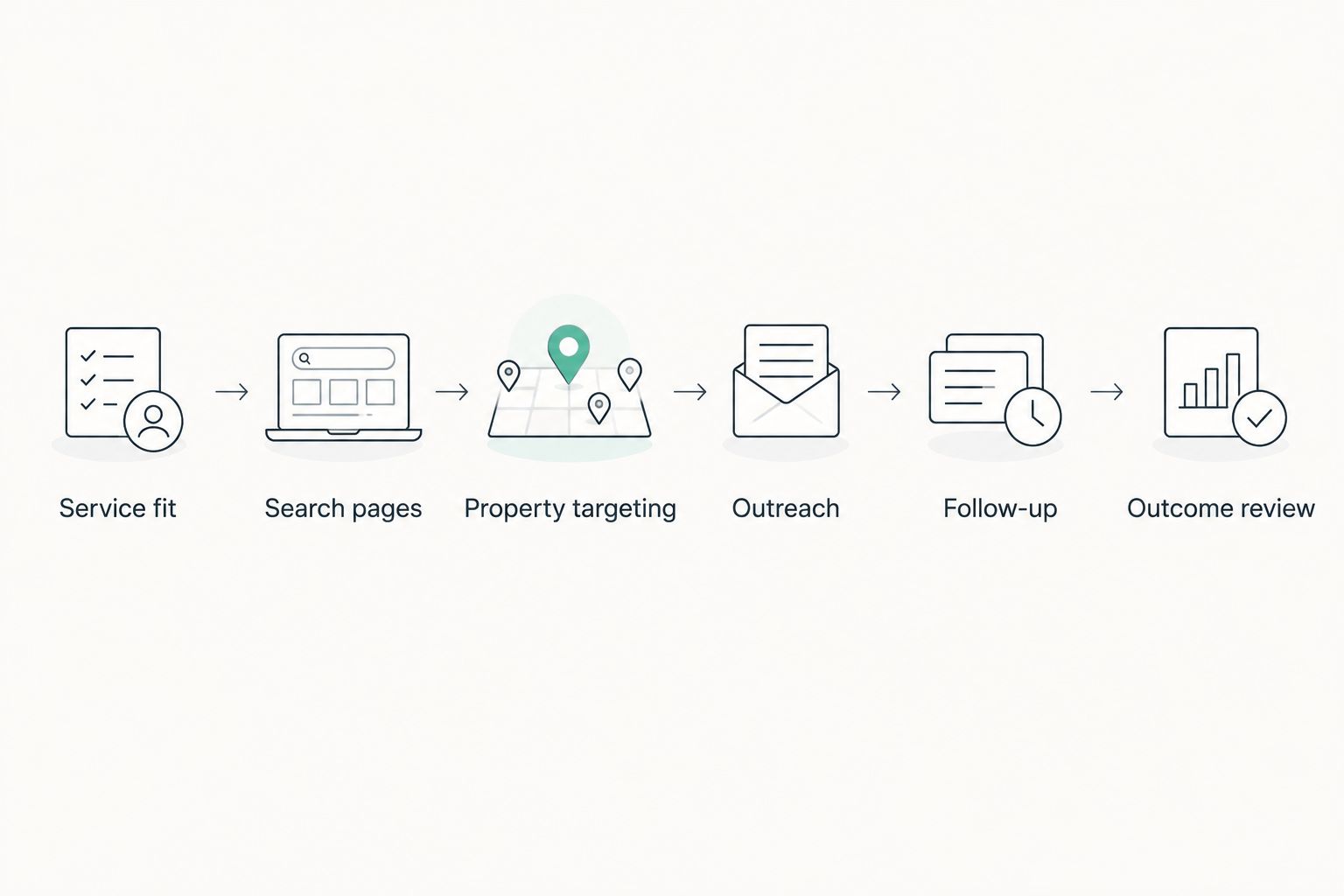
Connect acquisition records to qualification, proposals, and awarded work.
Compare Acquisition Routes by Their Job
Choose the route that reaches the relevant buyer or project, then judge what happens after the contact. These routes are not interchangeable.
| Acquisition Route | Use Case | What It Provides | Qualification Still Required |
|---|---|---|---|
| Local search and service pages | Residential owners and property representatives researching a reported problem | An inquiry tied to expressed interest | Territory, scope, authority, and technical suitability |
| Manual property or account research | Defined residential territories, condominium properties, and commercial accounts | A prospect list with a recorded selection basis | Actual need, responsible contact, and next decision |
| Professional referrals | Introductions from relevant trades and property professionals | Access to a contact or reported project | Scope, buying authority, and inspection evidence |
| Procurement monitoring | Municipal and other formally procured work | Notice of opportunities and requirements | Bid eligibility, scope fit, capacity, and commercial terms |
| CAST | Residential CIPP prospect selection in Florida | Parcel-level targeting intelligence from Felt & Resin | Inspection findings, measured scope, and project suitability |
You do not need every route in your 2026 plan. Use the routes your team can qualify and follow through. Adding another source does not repair an unowned pipeline.
Common Mistakes
- Counting Contacts as Projects. Report inquiries, inspections, proposals, and awards separately.
- Treating Estimates as Findings. A parcel score does not establish pipe condition. Estimated footage does not establish a quote.
- Mixing Segments in One Report. Separate residential, condominium, commercial, and municipal opportunities before judging source performance.
- Ignoring Buying Authority. Record who can approve or advance the next step before investing further sales time.
- Buying More Demand Before Fixing Follow-Up. Resolve unclear ownership and missing next actions before expanding acquisition.
FAQ
How should pipe lining contractors approach lead generation?
Start with the segment, territory, and work your operation can accept. Choose acquisition routes that reach the relevant buyers, then track qualification, proposals, and awarded work.
Should residential and municipal leads be measured together?
No. A residential inspection request and a municipal tender invitation represent different buying processes. Report them separately and use consistent qualification standards within each segment.
What information belongs in the first inquiry record?
Record the segment, location, reported problem or scope, contact role, and available inspection information. Assign an owner and a next action before closing the conversation.
What does CAST contribute to residential lead generation?
CAST provides parcel-level targeting intelligence for residential CIPP contractors in Florida. Felt & Resin's scores and estimated footage are modeled estimates, not inspection findings, measurements, or a basis for a homeowner quote.
Does Felt & Resin serve only residential contractors?
No. Felt & Resin serves trenchless pipe rehabilitation contractors across residential, high-rise and condominium, municipal, and commercial segments nationwide. CAST is the firm's residential-focused product.
Can property age establish that a home needs lining?
No. Construction era can support prospect selection, but it does not establish pipe material, condition, or suitability for lining. Those require assessment of the actual system.
What should a contractor review before increasing acquisition spend in 2026?
Review qualification outcomes, stalled opportunities, awarded projects, and the contribution from that work. Check ownership and next actions before paying to put more contacts into the same process.
Review the Losses Before Buying More Leads
Read the reasons opportunities were declined, stalled, or lost before changing the campaign. Out-of-area inquiries point to territory controls. Contacts without authority point to account research. Unanswered proposals point to sales follow-through.
Fix the stage that failed. More contacts will not resolve missing inspection records, an unclear scope, or a proposal nobody owns.